
What Happens to Women When Nations Are Born?
Honour Killings, Abduction and Belonging: A Review of Borders and Boundaries by Ritu Menon and Kamla Bhasin
The Partition of the Indian subcontinent into India and Pakistan in 1947 resulted in one of the largest human displacements of the twentieth century. Estimates suggest that around fifteen million people were forced to relocate in the aftermath of violence that claimed between half a million and two million lives. For decades, histories of Partition were dominated by nationalist narratives and statistical accounts of migration and death. Feminist historiography, however, has moved beyond these frameworks by recognising women not merely as supplementary to male history but as actors in their own right.
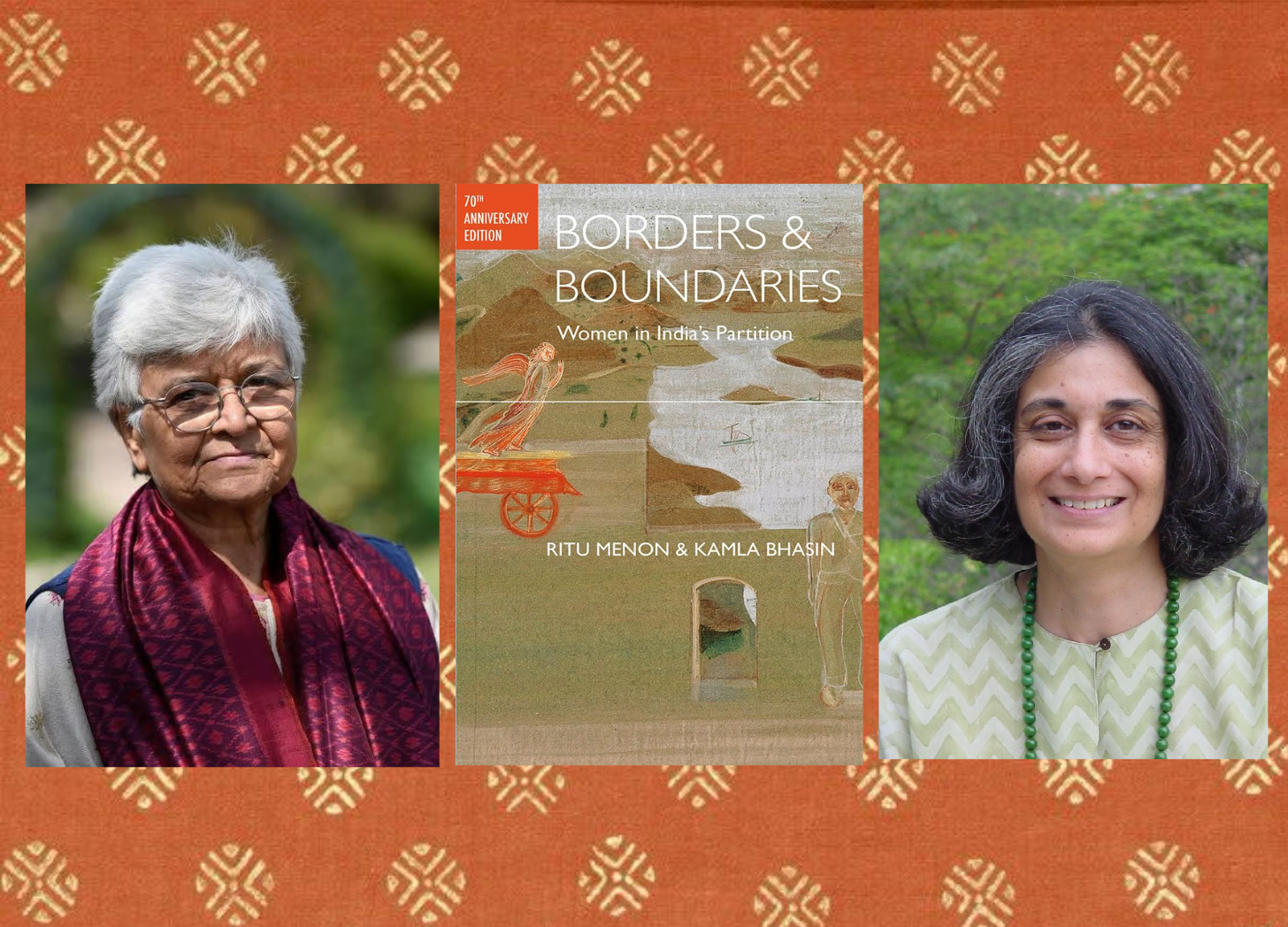
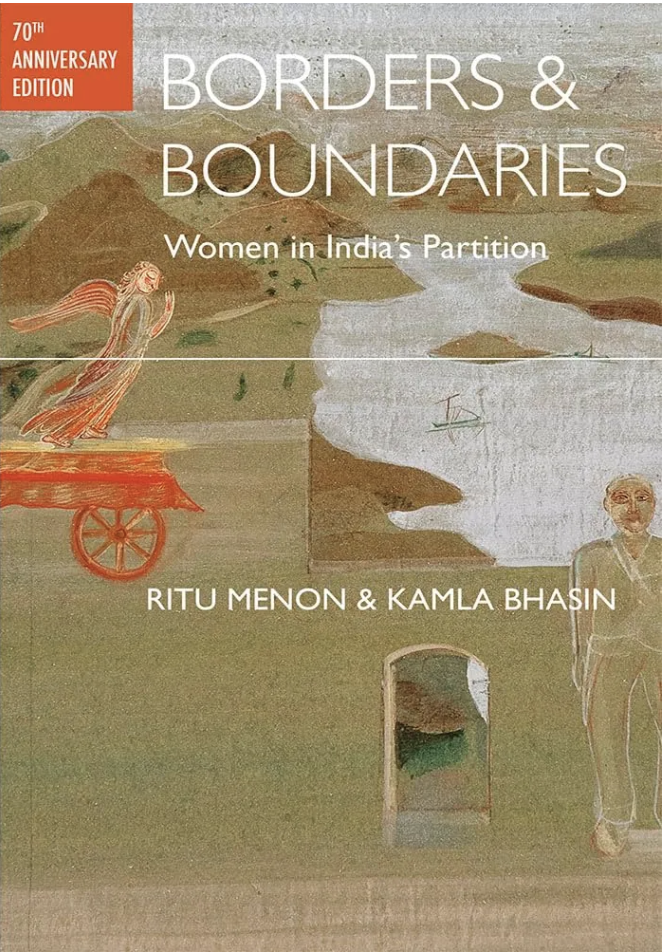
Borders and Boundaries, written by Ritu Menon and Kamla Bhasin, examines the relationship between the postcolonial Indian state and religious communities through a feminist lens. They use the memoirs and autobiographies of women social workers during the rehabilitation period as well as testimonies from refugees to show how personal narratives often contradicted official versions of Partition. Along with these memoirs is their own interpretation of such experiences in an attempt to understand a comprehensive history of the partition, one that does not render women voiceless but complements their narrative in a meaningful way.
Menon, a pioneer of the women’s movement in India, co-founded India’s first feminist publishing house, Kali for Women, in 1984 along with Urvashi Butalia. Bhasin (1946–2021) was a prominent feminist, author and activist who wrote extensively on patriarchy, gender, education and human rights. Their collaborative work in Borders and Boundaries dissects Partition’s violence and India’s recovery and rehabilitation programmes through a deeply gendered historical lens.
At its core, the book is organised around six thematic components- violence, abduction and recovery, widowhood, women’s rehabilitation, rebuilding and belonging. Each theme illuminates the negotiations between patriarchal families and the postcolonial Indian state in determining the honour and welfare of women. Methodologically, the book moves beyond simple binaries of victim and perpetrator. Instead, it blends personal testimonies with official policy reports to create a nuanced discussion of violence, recovery operations and the contradictions embedded within legislative and administrative attempts to repatriate women.
‘Honour’ in Death
One of the most disturbing aspects of the Partition violence was the way women’s bodies became symbols of communal honour. The book recounts episodes of violence committed not only by members of opposing communities but also by women’s own families. In many cases, such violence was perceived as ‘permissible’ within the logic of protecting honour.
A striking example cited in the book is that of Dr Virsa Singh, who is said to have killed between fifty and sixty women in Sheikhupura, including his own wife. Reflecting on his actions, he claimed, “I wasn’t a murderer, I was their saviour.” Such painful accounts depict how there was a powerful consensus on perpetrating violence against women in the name of community honour. At the same time, the authors highlight moments of resistance. Veeran, for instance, refused to poison herself and her daughter, quietly rejecting the expectation that death was preferable to dishonour.
Recovery: Of Who and For Whom?
A major part of the book examines the Abducted Persons (Recovery and Restoration) Bill passed in December 1949, which authorised the Indian state to recover abducted women from across the border. In practice, the legislation contained several ambiguities. Police officials were granted significant authority to identify ‘suspected’ abducted women, who could then be forcibly removed and repatriated to the country of their birth, sometimes against their wishes.
The question of children further made it ambiguous, as the legislation offered no clear provisions regarding their status. Nor did it allow women to challenge the decisions of recovery tribunals. Through parliamentary debates and conversations among social workers such as Mridula Sarabhai and Rameshwari Nehru, the book reveals numerous contradictions over the ethics of recovering women against their will.
Social worker Kamlaben Patel, who was stationed at Lahore between 1947-52, talks about her own harrowing experiences of recovering and rehabilitating Hindu and Sikh women post-Partition. In several cases, women had formed new lives and families, yet were still forcibly returned. Through such testimonies and policy debates, the authors show how questions of women’s rights, sexuality and belonging were constantly negotiated. As they argue, identities during this period were “in a continuous state of construction and reconstruction,” with the recovery of women becoming a matter of national prestige for both India and Pakistan.
Widows, Social Workers and Refugee Camps
One of the many consequences of Partition was the large number of women who were left widowed, often without a male family member to rely on. In East Punjab alone, refugee camps housed thousands of refugees migrating from West Punjab and nearby areas, with Kurukshetra being one of the largest. Widows from such camps were later accommodated at Karnal Mahila Ashram, where education, embroidery and tailoring classes were provided by state agencies and other organisations to help them become economically self-reliant.
Through conversations with widows such as Gyan Deyi and Durga Rani, Menon and Bhasin explore the pre-Partition lives of young women who were widowed during the violence and how they began working for other women’s causes. An important distinction raised in the book concerns the differing approaches adopted by the Indian state during recovery and rehabilitation. In the case of abducted women, state policy remained conservative, emphasising family and community authority. In contrast, policies directed toward widows often appeared more progressive, encouraging their participation in economic reconstruction through training programmes and employment opportunities.
Women social workers, many from middle-class backgrounds, played a crucial role in these efforts. Although their social work was genuinely motivated, they also held paternalistic attitudes about restoring women to where they ‘rightfully belonged’. The authors highlight the contradictory debates among these women as they attempted to understand the psychological experiences of displaced and abducted women. Such accounts reveal how attempts at women’s emancipation could coexist with deeply embedded patriarchal assumptions.
While the tragedy of Partition rendered many women helpless, it also created opportunities for women wishing to change the direction of their lives and emerge from the four walls of their traditional lives. Infused with a “spirit” (as Krishna Thapar calls it) of social change, many women joined educational institutes and the workforce, moving away from joint-family systems that broke down following Partition. Menon and Bhasin, in their own analysis of widows’ lives, suggest that there were both women who mourned for the loss of their comfortable lives after Partition uprooted their homes and families, as well as those who were forced to relocate and build a life from scratch, and eventually freed them from the shackles of patriarchy by educating their daughters.
Borders and Belonging
The dislocation caused by Partition was not merely geographical but also emotional. Through conversations with women who struggled to reconcile themselves with their relocation, the authors explore how belonging remained uncertain long after migration had ended. As they note, “there can be dislocation without one’s ever having been displaced.” This is certainly true for women who grappled with the insecurity of belonging neither ‘here’ nor ‘there’ with their families and memories divided and new borders drawn.
A noteworthy contribution of the authors is drawing parallel references to regional movements such as Sinhala nationalism, Sindh, Baluchistan and NWFP, Kashmir, etc., and the role of identity politics as the definition of nationality and nation keeps continually changing. This makes the book highly relevant to contemporary political debates on nationalism and identity politics that reconfigure belonging based on religious, linguistic and ethnic lines.
By using a feminist framework in understanding women’s identity as cultural bearers of a nation and biological reproducers of its community, Menon and Bhasin provide a richly nuanced debate on the interlocking relationship between gender, community and state. One of the limitations of the work is its heavy focus on women’s experiences from Punjab, where the scale and intensity of violence was comparatively higher than in the West and erstwhile East Bengal. The book also uses narrative testimonies from women who mostly belonged to the middle/upper classes, perhaps because records of women from lower classes were relatively lower.
Despite these limitations, Borders and Boundaries remains a groundbreaking contribution to feminist historiography of Partition in the ways it articulated the gendered language of politics, as national boundaries and identities were continuously being forged. It is a foundational read for understanding Partition through a feminist lens, as the authors explore women’s voices through their own narratives and memoirs. It is a must-have for those interested in gender, politics and religion, especially because it blends empirical research with discourse analysis.
By Sakshi Mavi
References
Priya Satia, “Stanford Scholar Explains the History of India’s Partition, Its Ongoing Effects Today,” news.stanford.edu, March 8, 2019, https://news.stanford.edu/stories/2019/03/partition-1947-continues-haunt-india-pakistan-stanford-scholar-says.
“Ritu Menon Partition Archive | Archives of Contemporary India,” Ashoka.edu.in, 2021, https://archives.ashoka.edu.in/sub_community/89.
“The Personal and Political | Living Feminisms,” Livingfeminisms.org, 2026, https://www.livingfeminisms.org/story/personal-and-political.
Ritu Menon and Kamla Bhasin, Borders and Boundaries : How Women Experienced the Partition of India. (New Brunswick N.J.: Rutgers U.P, 1998)., p.49-50.
Ibid., p.54.
Ibid., p.73.
Ibid., pp.73-89.
Ibid., p.98.
Ibid., p.133.
Ibid., pp.136-148.
Ibid., p.199
Social Worker at Gandhi Vanita Ashram, Jullandhar, East Punjab.
Ritu Menon and Kamla Bhasin, Borders and Boundaries : How Women Experienced the Partition of India. (New Brunswick N.J.: Rutgers U.P, 1998)., p.230.