
Zarina Hashmi’s Dividing Line as Fragmentary History
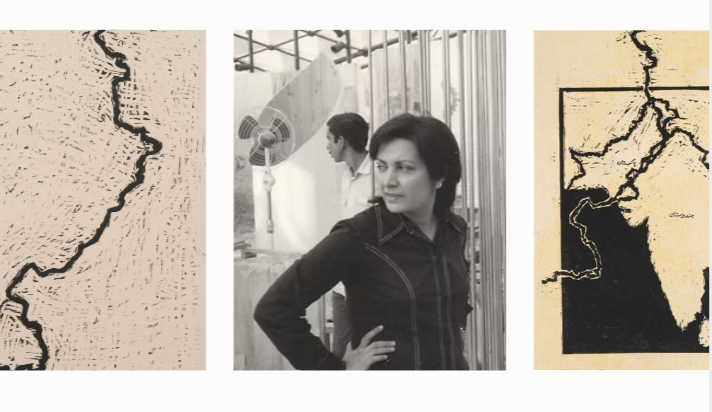
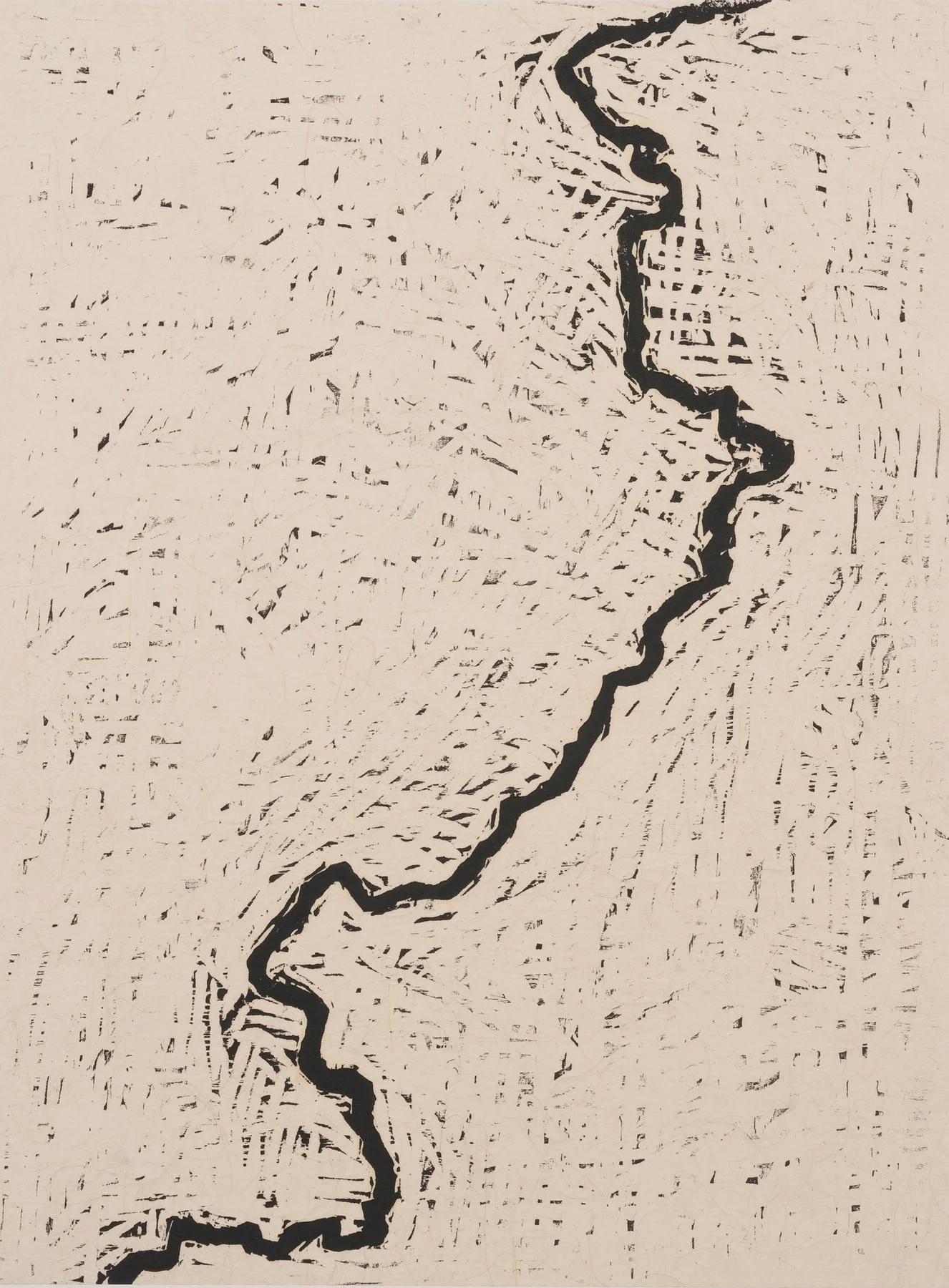
This is Zarina Hashmi’s woodcut print, Dividing Line (2001), which depicts a single thick black line that meanders across handmade paper. It has no clear beginning and no definitive end.
Since the Partition itself, art has served as a profound record of displacement, loss, and memory. Artists have used textiles, painting, and installation to navigate personal and collective histories, employing maps, fragments, and intimate objects to explore the enduring impact of borders decades after the event. Among these artists, Zarina Hashmi occupies a unique position, not simply as a chronicler of Partition, but as someone who lived its ruptures and transformed them into visual testimony.
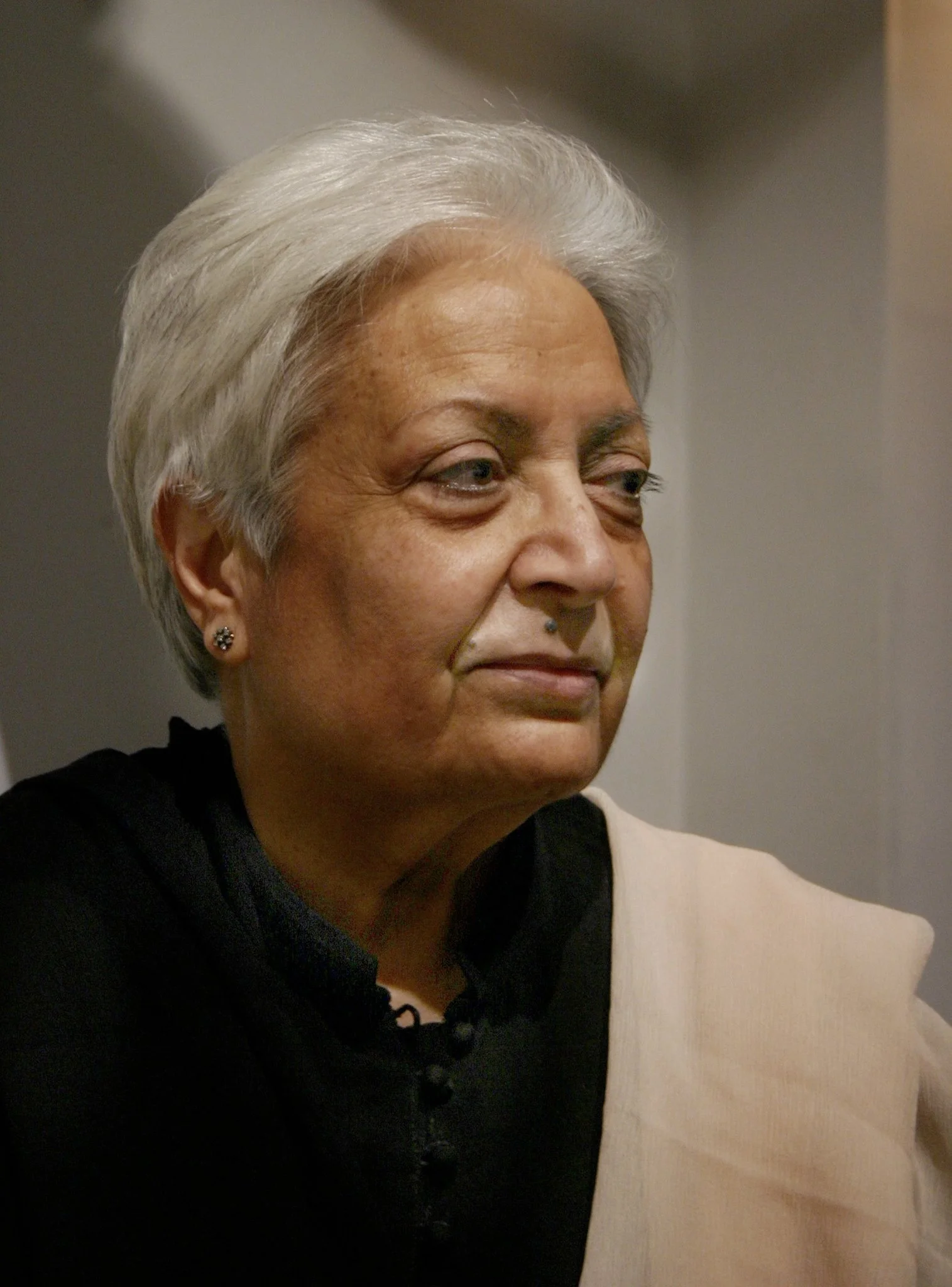
Zarina Hashmi was born in Aligarh, Uttar Pradesh, in 1937, and at the age of ten, she fled with her family to Karachi during Partition. Although first educated in mathematics, she turned to art after marriage, and her life became a journey that took her across the globe. Her work grappled with themes of exile, displacement, and the elusive idea of home. Her pieces, today,are housed in major institutions such as the Museum of Modern Art in New York and San Francisco, as well as the Tate in London. Art critics often describe her work as incorporating motifs and geometry from Islamic decoration, though such labels fail to capture the quiet power of pieces like Dividing Line. Upon reflection, this piece's central element, the singular black line, remains ambiguous with its lack of textual details.
It thus prompts us to ask: what can a single mark teach us about writing histories that resist nationalist narratives - narratives that smooth over nuance, marginalise less state-censored voices, and present the past as a singular and inevitable story?
Embodying the Line that Lives and Wounds
Zarina’s Dividing Line is, most immediately, a reflection of the geopolitical Indo-Pakistan border, the line that split a unified Indian subcontinent in 1947 into two, leaving behind an enduring scar. Yet the line in the print has no clear beginning or end, mirroring the lived experience of Partition. In this way, the work becomes a tool for analysing history from a ‘bottom-up’ perspective: rather than presenting Partition through maps, treaties, or official declarations, it distils the event to a single, unstable line. Stripped of cartographic symbols and national markers, the border is reduced to its most elemental form, not as a fixed geopolitical fact, but as a lived fracture that shaped individual bodies, memories, and migrations.
As the line travels across the paper without clear annotations to guide us, it reminds us of the psychological currents of dispossession and misrecognition that Partition evokes for many who lived through it. In pointing us toward such themes, it brings us into the territory of subaltern and minority histories, where what is absent becomes as important as what is preserved in official archives. As scholar Aparna Kumar astutely notes in his review of the piece, this approach specifically draws on Gyanendra Pandey's 'defence of the fragment' in subaltern studies, which argues that fragments are not failures of knowledge but legitimate forms of historical testimony. Zarina's work insists that memory can survive even in silence, even in the gaps between words.
While some borders are present, others are conspicuously missing in this piece. There is, for example, no East Bengal, later Bangladesh, and there is no Line of Control in Kashmir. These absences are indeed intentional. The absence of such details resists nationalist closure and refuses a single, state-sanctioned story of Partition. It reinforces the idea that what is missing from archives is equally as important, if not more so, than what is preserved. Perhaps it is the structure of the line that best embodies this, as it seems to evoke the fluid movement of Urdu calligraphy, yet the work incorporates no written text. This tension gestures toward another kind of loss. Partition did not only displace people; it unsettled languages, cultural centres, and entire ways of belonging. Urdu, once rooted in shared urban and literary worlds, found itself politically reclassified and rendered suspect in both India and Pakistan. What was displaced, then, was not just populations but forms of grounding - linguistic and cultural. Therefore, by invoking calligraphic motion while withholding script, Zarina asks us to look beyond what can be archived or officially recorded, and instead attend to absence itself as historical evidence.
Simplicity as a Springboard
Ironically, however, the simplicity of Dividing Line is what urges its viewers to adopt new lenses and connect new threads. By embracing simplicity, space is further created for viewers to think with new frameworks. In my personal experience analysing the piece, this was most evident. While I immediately gathered that the artwork reflected the Radcliffe Line of 1947, it was the sheer lack of details, which could have made it a literal map, that encouraged me to engage with the work as a revisionist interpretation of history. In sparking this greater willingness to reimagine how we interpret Partition, boiling it down to simply the imposed border, the artwork facilitated a connection in my mind to Ilyas Chattha's work on the Punjab borderland.
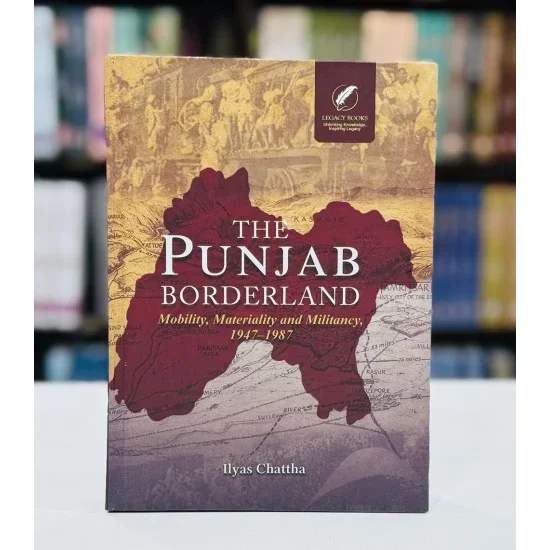
Chattha’s piece emphasises that alongside the line which divided the continent, also came new borders. In The Punjab Borderland: Mobility, Materiality and Militancy, 1947–1987, Chattha argued that by looking at Punjab through the lens of borderlands, it becomes clear that there are strong examples of increased cross-border mobility and materiality which can be considered forms of post-Partition resistance in the region. Specifically, his research reveals that those living in the borderlands did not passively accept the international boundary. Rather, they transgressed it, lived across it, traded through it . Local populations increasingly capitalised on a porous border, participating in contraband trade that served all levels of society. Smugglers brought the divided cities of Lahore and Amritsar closer through contraband networks, utilising their pre-Partition connections even when India and Pakistan terminated all commercial and social links. The border, thus, far from being merely a space of trauma, also became a zone of blending, creative interface, and resource circulation. Borderland communities were active participants, not passive victims. By helping me take a step back and removing connotations of the border as a static marker, it can be reimagined as something more living.
Zarina's single black line depicts borders as contested spaces, which people navigated, crossed, and reimagined daily. This is perhaps the most powerful element of artwork like Zarina's. Its very simplicity becomes a springboard, stripping away preconceptions to help us form new and unconventional understandings of Partition histories. It underscores the crucial importance of Partition art itself, not just as decoration or illustration, but as a tool for thinking, remembering, and resisting. It reminds us that histories of Partition cannot be reduced to a single date or event, as they reverberate across generations, across borders, and across bodies.
Materials as History: Paper, Documents, and Survival
That being said, it's equally important to return, for a moment, to the more concrete details of Zarina's art: the materials from which it was constructed. Dividing Line is a woodcut print, with a line drawn in black ink on handmade Indian paper. This is no accident; materials themselves indeed carry histories.
In South Asia, paper is intimately tied to empire, bureaucracy, and survival. Handmade Indian paper, produced through repetitive, embodied processes, links back directly to periods of Mughal bureaucracy, British colonial rule (the Kaghazi Raj or 'Paper Rule'), and Partition, as documentation such as identity papers, permits, and borders became increasingly important. The paper can therefore not be regarded as neutral; it is complicit, political, and intimate. The fact that Dividing Line is mounted on Arches Cover white paper creates a layering that embodies colonial histories themselves. The Indian handmade paper pressed against Western archival paper mirrors the entangled forces that drew the Radcliffe Line but also the wider histories of Empire. As Bhavani Raman has shown in Document Raj, paper became central to colonial governance, an active agent in the production of power rather than merely a surface for inscription. This legacy endured into the moment of Partition, where documentation became a condition of mobility and survival.
Yasmin Khan emphasises in The Great Partition that Partition was not only a political rupture, but an administrative process marked by bureaucratic improvisation and documentary chaos, in which lives were made legible or illegible through paper. Thus, rather than treating Partition as a rupture detached from earlier material worlds, Zarina's paper situates 1947 within much longer histories of Mughal bureaucracy and colonial documentation. In the mid-1960s, Zarina apprenticed with the famed British printmaker Stanley William Hayter in his Parisian atelier, learning to work with paper's varying textures and qualities. And so it is clear that her attention to materiality was deliberate.
What does it mean, then, to read Zarina as a material historian? Her use of handmade Indian paper situates her work within what historians have described as the 'material turn' in global historiography. Rather than treating objects as passive illustrations of historical events, this ‘material turn’ insists that things themselves carry historical knowledge, which is embedded in their circulation, production, and use. As scholar Giorgio Riello argues in his 2022 article in the Journal of World History, material artefacts are often more mobile than people, acting as agents of global connections. The ‘material turn’ shifts focus from exclusively human stories to include the agency of objects. Hence, Zarina's use of paper hints at her participation in this historiographical shift, redirecting the interpretation of her artwork towards an understanding of how materials continue to reflect memories of survival and bureaucratic violence, in the wake of Partition.
While much historical discourse has focused on luxury goods and elite exchange (porcelain, emeralds, spices, textiles), Dividing Line insists that mundane materials (paper, ink, wood) are equally global, and far more violent in their consequences. Matthew Hull's analysis of the 'materiality of bureaucracy' in Government of Paper helps clarify how documents operate not only as records, but as technologies that shape social reality, making paper both intimate and complicit;it is handled daily, yet remains capable of enforcing extreme borders and exclusions. In this way, Zarina utilises the ‘material turn’ as a visual correction to nationalist timelines of Partition.
Toward an Ethics of Fragmentary Memory
In its entirety, Dividing Line offers more than artistic representation. It offers a method for approaching traumatic histories, which refuses neat reconciliation and the demand for a total archive, one which is a complete, exhaustive repository of all records, voices, and traces of the past that captures history in its entirety, without omission, distortion, or power imbalance.
Fragments are not deficiencies, but forms of knowledge that preserve what official archives cannot or will not hold. In prioritising fragments, silences, and absences, Zarina's work creates a space for marginalised memories to exist as central and legitimate. Here, they are not footnotes to grand narratives of independence. The line carved into paper continues to reverberate; it asks us to consider not just what happened in 1947, but what continues to happen in border towns, refugee camps, and daily negotiations of identity.
Borders are not just lines on maps; they are wounds that refuse to heal, scars that shape how we move through the world. Zarina proposes an ethical approach of sustained attention to pain, absence, and uncertainty. A refusal of closure, which insists that memory remain a living and unfinished practice, allowing a deeper reckoning with a past that continues to shape our present.